

The interview is booked, and the quiet fear is always the same: the follow-up question that exposes the gap between your pitch and your proof. For executive interview preparation in Singapore, our editorial team suggests bringing an example and a record rather than a louder adjective.
An unrehearsed answer can leave a story without supporting detail or a claim without a period. A customer may not have agreed to be named.
Preparation closes that gap before the recorder switches on. It protects you in the room, and it protects the reader afterwards, because a checked fact builds more trust than the boldest slogan ever will.
In this blog, we discuss how Singapore SME founders can prepare for an interview. We cover sample questions, answer structure, disclosure boundaries, a suggested worksheet, and factual checks and correction requests.
What Does Executive Interview Preparation in Singapore Involve?
Our editorial team's suggested approach is to turn themes into answers backed by examples and locatable records. Prepare before the session so you can respond to follow-up questions without relying on a memorised script.
Possible themes include your background, the customer problem, differentiation, a consequential decision, customer benefit and a setback. Singapore-specific operating lessons and your next priority may also help readers.
The sample prompts in the table below are model-generated suggestions, not a confirmed Singapore Brand questionnaire. Practitioner approval is needed before attributing them to our team. Use them to identify the customer, the problem and a business decision with a useful lesson.
If you have read our earlier guide on how to get featured in the Singapore media, you will recognise the pattern. Explain the business to a reader who has never heard of it.
Seven Sample Executive Interview Questions for Singapore Founders
| Sample question | What it tests | What to prepare |
|---|---|---|
| Who is your customer, and what problem do they pay you to solve? | Whether you can explain the business without a slogan | A one-sentence answer naming the buyer and the specific problem |
| What happened that convinced you this problem needed a business? | Whether the origin story is observable, not polished | A real incident you can describe in plain language |
| Walk us through one recent customer engagement, from enquiry to outcome. | Whether the promised value survives actual delivery | One engagement you can narrate step by step |
| Which decision did you get wrong, what did it cost, and what changed? | Accountability, and a lesson another operator can use | The decision, its consequence and the operational change |
| What evidence supports your main claim of being different? | Whether differentiation is defensible, not adjectives | The operating advantage and how a reader could verify it |
| What is difficult about serving customers in Singapore, and how have you adapted? | Local operating detail, not generic competition talk | A Singapore-specific constraint and your adaptation |
| What should a buyer check before choosing a provider in your category? | Whether you help readers decide, not just sell | A neutral buyer checklist, including questions for your own firm |
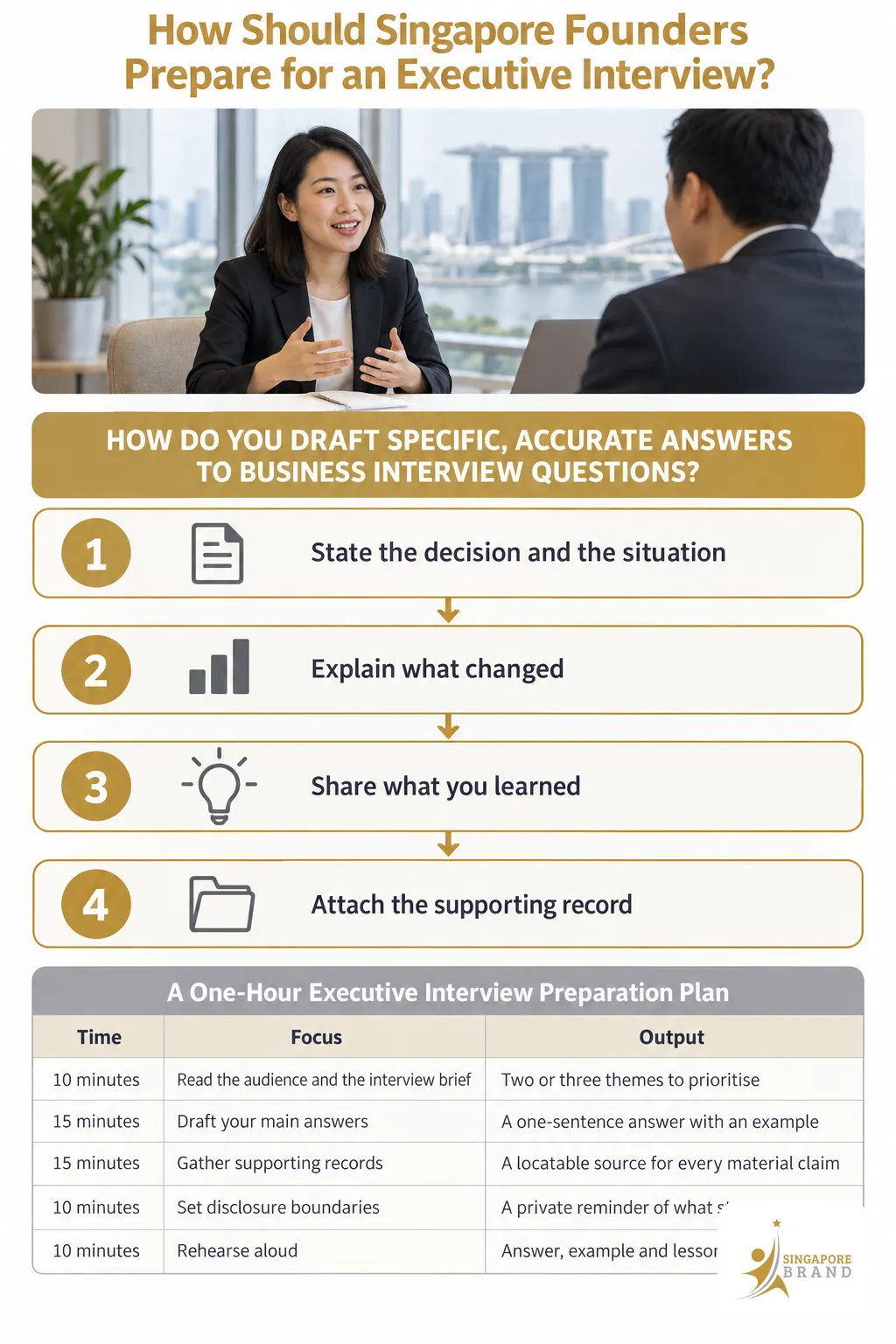
How Do You Draft Specific, Accurate Answers to Business Interview Questions?
Our editorial team suggests starting with the claim or decision, then explaining the situation, what changed and the lesson. This is preparation advice, not a confirmed house method. The delivery examples below are hypothetical, not accounts of actual interviews.
1. State the decision and the situation
Name what you chose and what forced the choice. Saying you changed your dispatch process is weaker than saying you changed it after customers kept chasing you for arrival times.
2. Explain what changed
Describe the operational change, not the intended virtue. A dispatch cut-off and a departure message are checkable. A relentless focus on excellence is not.
3. Share what you learned
Offer a lesson another operator could apply. The most useful ones usually cost you something, such as admitting what still does not work.
4. Attach the supporting record
Know which document supports the claim and who owns it. For a material figure, prepare its period, definition, calculation and a locatable record. Omit a number you cannot substantiate. When comparing results, check whether periods and populations are comparable, and consider other possible explanations.
Weak Claims Versus Better Prepared Answers
| Answer type | Weak version | Better preparation |
|---|---|---|
| Positioning | We are Singapore's leading provider with unmatched quality. | Explain the mechanism behind the service and give buyers a checklist, without superlatives you cannot support. |
| Improvement claim | Our service improved after we changed our process. | Define the measure, the period, the change and its source record; say whether it is internal data or an independent assessment. |
| Expansion claim | We have entered the regional market. | Distinguish a registered entity, an operating office, a distributor relationship and actual sales. |
| Customer proof | A major client trusts us. | Use a cleared reference, or explain your standard onboarding process without identifying the customer. |
How Should a Founder Handle Confidential Topics in a Media Interview?
You settle the boundaries before the session, with whoever authorises disclosure inside your company. Check your confidentiality obligations before sharing. Setting a boundary need not mean refusing to engage.
Two traps catch founders. Anonymising a client does not guarantee they cannot be identified. And 'off the record' is not a label you can attach after saying something; the treatment must be agreed with the interviewer before the information is shared. Our simplest advice: do not disclose sensitive material merely to explain why it is sensitive.
The reliable pattern is a boundary followed by something useful you are cleared to share. The responses below are illustrative wording, not approved disclosure language; your boundaries depend on your contracts and internal approvals.
1. Pricing
Decline the negotiated rate, then help buyers compare: ask whether implementation, support and exit costs sit inside the quote.
2. Client names
Decline to identify the customer or discuss their results, then explain your standard onboarding process instead.
3. Unreleased plans
Decline a launch date, then describe the customer problem you are solving and the capabilities available today.
Disclosure Boundaries for Sensitive Interview Topics
| Topic | Avoid | Say instead |
|---|---|---|
| Pricing | Quoting a negotiated customer rate | What buyers should compare in quotes, such as implementation, support and exit costs |
| Client names | Identifying a customer or discussing their results | Your standard onboarding process as the cleared alternative |
| Unreleased plans | Hinting at an imminent launch without substance | The customer problem being solved and the capabilities available today |
| Anything sensitive | Assuming 'off the record' applies after disclosure | Agree the treatment with the interviewer before sharing, or leave the detail out |
What Does a Founder Interview Preparation Worksheet Look Like?
Our team suggests a worksheet to organise your preparation; it is not a confirmed Singapore Brand template. Pair each likely question with an answer, example, supporting record and disclosure status.
Give your worksheet these columns:
- Likely question
- One-sentence answer
- Specific example
- Shareable fact, with its date or period
- Supporting record and its owner
- Why the fact matters to a reader
- Disclosure status: publishable, needs clearance or do not disclose
- Unresolved check
Under the supporting record, name something locatable, such as a dispatch export and its owner, rather than 'our data'. Keep confidential figures and client details out of any worksheet you hand to the interviewer. Writing 'off the record' on a shared document does not create an agreement with a journalist.
Reconcile any material figure with your accountant before the interview, so what you quote matches the books rather than a sales deck.
The one-hour table is a suggested allocation, not a tested house method. Rehearse aloud in this order: answer, example, lesson. Prioritise well-supported points over ambitious claims. Mark unresolved claims for verification or removal rather than memorising them more confidently.
A One-Hour Executive Interview Preparation Plan
| Time | Focus | Output |
|---|---|---|
| 10 minutes | Read the audience and the interview brief | Two or three themes to prioritise |
| 15 minutes | Draft your main answers | A one-sentence answer with an example for each theme |
| 15 minutes | Gather supporting records | A locatable source for every material claim |
| 10 minutes | Set disclosure boundaries | A private reminder of what stays confidential |
| 10 minutes | Rehearse aloud | Answer, example and lesson, in that order |
How Do Factual Checking and Corrections Work After an Executive Interview?
Before the interview, ask what factual checking the publisher offers and who handles queries. A focused query can identify the proposed wording, the fact to confirm and its supporting record.
The Accounting and Corporate Regulatory Authority (ACRA) provides access to business information. An ACRA business profile can help check registered particulars. Do not assume the incorporation date is also the date trading began.
1. Before the interview
Ask about recording, its purpose, attribution and who handles the material. Also clarify factual review, query deadlines and how to request a correction. If you decline recording, ask whether written answers are an option.
2. During factual checking
Our team suggests checking names, titles, product availability, customer attribution, awards and material figures. Confirm registered particulars with your company secretary before they appear in print. The actual checks and reviewers should be agreed with the publisher.
3. After publication
To request a correction, identify the exact passage, the proposed correction and the evidence. Ask the publisher how corrections are handled; a visible correction is not guaranteed. A factual check does not automatically give you approval over the article. Ask what review, if any, is offered.
How Should Early-Stage Startups and Established Brands Prepare Differently?
Prepare according to the evidence your business can honestly produce, not the impression you want to make. Our team suggests adapting questions and answers to the business stage; this is not a confirmed interviewing approach.
1. Pre-revenue startups
Expect questions about what has actually been tested, who participated, whether anyone has paid and what changed after the feedback. Keep expressions of interest separate from signed customers and paid orders.
2. Established brands
Expect questions about consistency: what happens when the founder is absent, how complaints are handled, and whether a claimed improvement holds across locations or customer groups. If you claim regional expansion, name whether you mean a registered entity, an operating office, a distributor relationship or actual sales.
3. Nervous founders
Ask for the main themes in advance, rehearse a few anchor answers, and agree how you can pause to check a fact. Say you need to verify an uncertain figure, and ask how to provide it afterwards. Where a story touches regulated services or a dispute, specialist review before publication is wise.
Conclusion
An executive interview rewards founders who prepare answers, not slogans. Choose your themes and pair each claim with an example and a locatable record. Set disclosure boundaries before the session and ask what factual checking is offered.
Get those right, and the finished feature says something more durable than a pitch: who you serve, what you learned and why a reader should believe you.
At Singapore Brand, we tell the stories behind homegrown businesses through executive interviews, editorial features and our curated guides. If you would like your founder story told well, our editorial team would be glad to hear from you.
Ready to Tell Your Founder Story?
Prepare your answers, evidence and disclosure boundaries, then let our editorial team share what makes your Singapore business worth believing in.
Frequently Asked Questions
A suggested one-hour plan is to read the brief, draft answers, gather records, set boundaries and rehearse. Agree any deadlines with the interviewer.
Say so, and offer to check and send it afterwards. Editors prefer a verified number delivered later to an invented one on the spot. Agree the follow-up arrangement when the interview is booked.
No. Set your boundaries with your internal approver before the session, state them plainly, and offer a cleared alternative such as your standard process or a buyer checklist.
Ask at the booking stage what review, if any, is offered. Factual checking does not automatically give you blanket approval over the article.
Point to the exact passage, propose the correction and provide your evidence. Ask the publisher how to submit the request and how corrections are handled.

Singapore Brand
Author
We are dedicated to promoting and celebrating business brands in Singapore. We share the inspiring success stories of homegrown brands, highlighting their achievements and growth.