
Appearing in a business guide gives a Singapore SME a public reference point, but it demands careful follow-up. In a crowded SME market, a curated listing can help readers verify what was published. It does not, by itself, establish an award, endorsement or ranking.
There are advertising and intellectual-property principles to respect. ASAS says advertisements should be honest and truthful and should not mislead through inaccuracy, ambiguity, exaggeration or omission. IPOS advises users to seek permission before using a third party's copyright work.
Readers can check a claim against the live article. A precise citation helps them understand the feature in context. An overstated claim can create the opposite impression.
In this blog, we discuss the first-30-day checklist for a featured Singapore SME: accurate citations, article reuse, enquiry follow-up, practical measurement, regulated sectors and current government support.
Which Steps Matter After You Are Featured in a Business Guide?
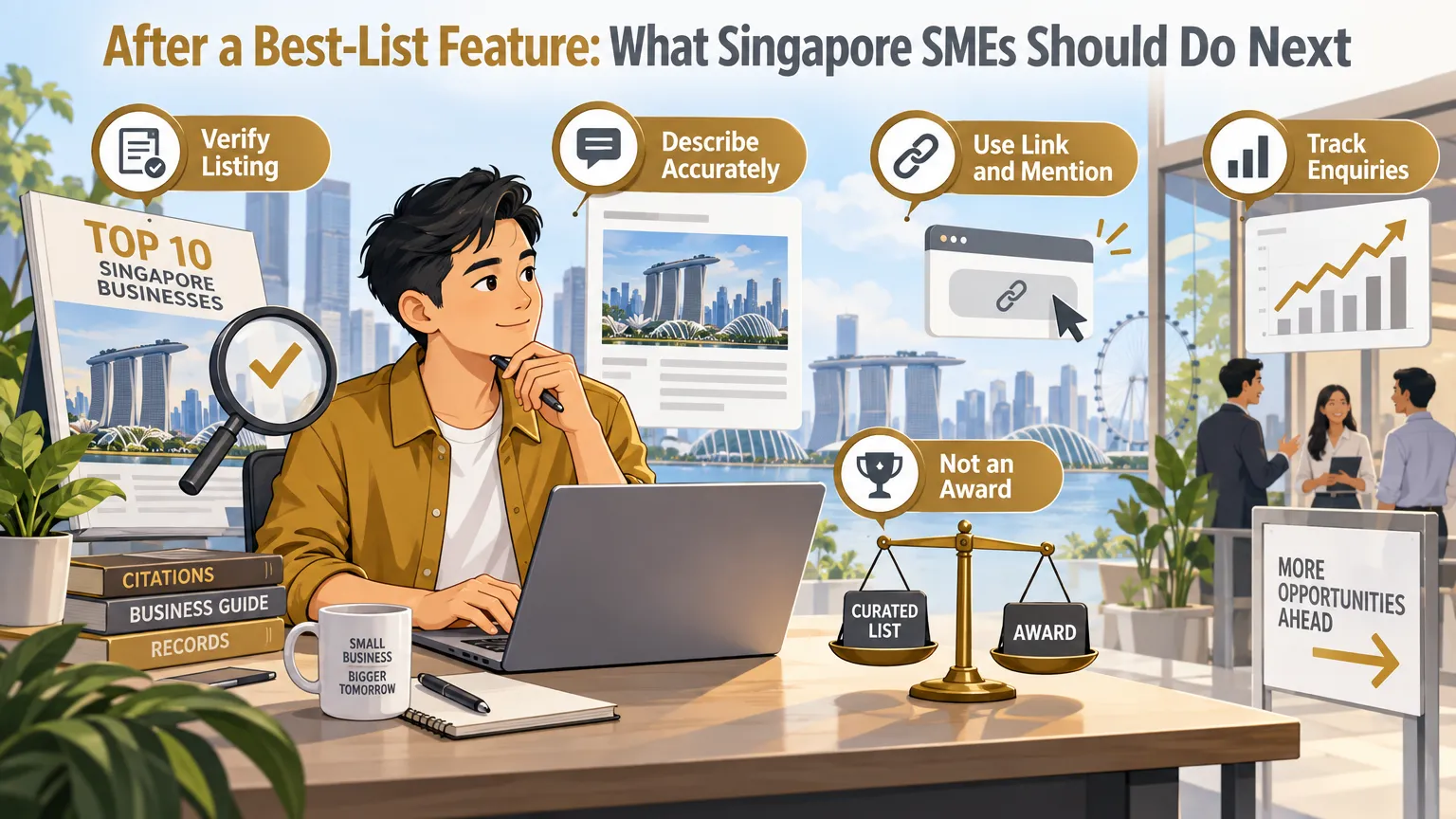
Use the first month to verify the listing, record the citation, update selected customer-facing channels, set up trackable links and brief staff.
As a publishing team, we offer this Singapore SME media feature checklist as an editorial recommendation. It reflects our judgement about the checks that help protect accuracy. It is not a documented internal process or evidence that any step produces enquiries.
Your entry may sit in a broad business directory or a niche roundup. A Top 10 security companies in Singapore list is one example. Spend the first week getting the basics right before amplifying anything.
Step 1: Verify the live listing
Read your entry as a customer would. Check the company name, category, description, contact details and every link. If something is wrong, tell the publisher immediately — a small correction early protects the citation you will rely on for months.
Step 2: Record the citation details
Save the publisher's name, the guide title, the category, the edition year and the live URL in one place. This single note keeps every future mention accurate, from proposals to social captions.
Step 3: Update customer-facing channels
Add a factual line to your website. Post an update on your Google Business Profile and refresh your email signature and social bios. Keep the wording identical everywhere.
Step 4: Set up trackable links
Use tagged URLs when you link from the announcement to your own pages, so referral traffic can be separated from other sources later.
Step 5: Brief front-line staff
Sales and customer-service teams should know what the feature says and where to send readers. A team that cannot answer the question of where you were featured wastes the mention.
Step 6: Publish one honest announcement
Share the publisher's original post using the platform's native share function, or post a factual caption with a link to the live guide. Resist superlatives at this stage.
Your First 30 Days After the Feature
| Timing | Focus | What good looks like |
|---|---|---|
| Days 1–7 | Verify and record | Listing checked, citation details saved, errors reported to the publisher |
| Days 8–14 | Announce accurately | One factual post published, channels updated, staff briefed |
| Days 15–21 | Convert the attention | Citation placed on service pages, call to action live |
| Days 22–30 | Measure and plan | Tagged links reviewed, leads asked how they found you, next coverage planned |
How Should You Describe Your Inclusion Without Overstating It?
Describe exactly what happened. Name the publisher, the guide, the category and the year. Do not upgrade an inclusion into an award, certification, endorsement or first-place ranking. This is not just etiquette. The Singapore Code of Advertising Practice, administered by ASAS, expects advertisements to be honest and truthful, and not to mislead through inaccuracy, ambiguity, exaggeration or omission.
A numbered position in a curated article also does not necessarily mean you were ranked first, or above other businesses. Unless the guide expressly states that it is ranked and explains its ordering, treat the number as layout, not a league table position.
The wording we suggest is prudent practice pending the publisher's confirmation — including ours. If you have been featured by Singapore Brand, ask us to confirm the approved citation for your specific guide before printing anything on brochures or running paid media.
Accurate Wording vs Overclaiming
| Accurate phrasing | Risky phrasing |
|---|---|
| Featured in [publisher]'s 2026 Best [category] in Singapore guide | Award-winning [category] company |
| Named among the Top 10 [category] in [guide title], 2026 | Ranked #1 in Singapore |
| Included in [publisher]'s curated picks for [category] | Certified or endorsed by [publisher] |
| Read the full guide here | Voted Singapore's best [category] |
| Featured in the 2026 edition | Current titleholder, after a newer edition is published |
What Can You Reuse From the Article Without Permission?
Treat a simple link to the live article and a short factual reference as starting points, not blanket permission. Whether a use is appropriate depends on the publisher's terms, the asset and the context. Republishing the article, reusing photographs or designed graphics, or creating a publisher-logo badge can require permission. The Intellectual Property Office of Singapore explains how copyright applies. Copyright owners control reproduction, publication, communication and adaptation of their works. It recommends permission before using a third party's copyright work.
Do not assume a universal safe threshold, such as a fixed number of words or sentences. Rights depend on the asset, any statutory exceptions, the publisher's terms and any licence. Check the publisher's website terms, and where your intended use goes beyond a factual reference or link, request a written licence or permission.
The same caution applies to badges and logos. Any supplied badge should follow the publisher's specific asset guidelines and written permission, and logos may be protected by both copyright and trade-mark rights. When in doubt, ask the publisher for its current asset rules rather than improvising your own artwork.
What You Can Reuse and What Needs Permission
| Intended use | Usual starting point |
|---|---|
| Linking to the live article from your website or profile | Generally acceptable where it implies no endorsement or affiliation |
| A factual one-line citation of your inclusion | Low risk when the wording is exact |
| Sharing the publisher's own social post | Use the platform's native share function |
| Quoting an excerpt or screenshotting your listing | Check the publisher's stated terms first |
| Using a 'featured in' badge or the publisher's logo | Only with a supplied asset, its guidelines and written permission |
| Republishing the article, photos or designed graphics | Obtain written permission or a licence |
Is a Curated-List Inclusion the Same as an Award or News Coverage?
Not necessarily. A curated-guide entry is an editorial distinction, not automatically an award, certification, independently verified finding or exhaustive market ranking. What an inclusion means depends on the specific guide's stated methodology, disclosures and wording. Assess each feature on its own terms rather than applying a blanket label.
Honesty also extends to how the feature came about. If a business pays for placement, enhanced visibility or promotional content, ASAS guidance requires clear disclosure. This applies where a client sponsors content space for a mention or pays for marketing messages in content. Paid inclusion should never be presented as independently earned editorial recognition.
If you are weighing paid options, our guide on how should Singapore SMEs choose a paid business directory covers the questions worth asking before you commit. And if you want certainty, ask any publisher for its current terms, methodology and commercial-disclosure information where relevant.
How Do You Turn a Top 10 Listing Into Real Enquiries?
Place the mention where decisions happen. A feature works hardest beside a relevant service page, quote-request form or booking flow — not as a standalone publicity post that disappears from feeds within a day. We offer the four moves below as practical recommendations from our editorial vantage point, not as measured outcomes.
1. Put the citation on your key service and conversion pages
Add the accurate one-line citation to your main service pages, about page and sales proposals, with a link to the live guide so prospects can verify it themselves.
2. Pair the announcement with a call to action
A home-services business could place its guide mention directly above its quote form. This puts the citation beside the action it wants readers to take.
3. Extend the story across channels
Reuse the guide's theme in your newsletter, professional networking posts and customer conversations. For complementary ideas, our article on branding strategies for Singapore SMEs offers further approaches.
4. Plan the next piece of coverage
One feature opens the door to more. If you are ready for the next step, our guide to getting your brand featured in Singapore media explains how to prepare your story and approach publishers.
How Do You Measure Whether the Feature Actually Worked?
Use tagged links, annotate the publication date in your analytics, and ask every new lead how they found your company. These are practical measurement options from our publishing perspective. They may show attention, but they cannot prove that the feature caused a particular enquiry or sale.
Keep the interpretation honest. A rise in branded searches, referral visits or WhatsApp enquiries after publication is a useful signal, not a controlled result. Compare the period with the weeks before publication. Note any other campaigns running at the same time.
Keep a simple record of publication dates, links and lead-source answers. Use it to guide future follow-up, without presenting it as proof of the feature's commercial effect.
What Extra Rules Apply in Regulated Sectors?
Several regulated sectors carry extra advertising rules. The three below are common for featured SMEs. Get internal compliance review before using a feature.
1. Financial advisory services
Regulation 22 of the Financial Advisers Regulations [sso.agc.gov.sg](https://sso.agc.gov.sg) applies to specified persons publishing investment-product advertisements. It requires the advertisement not to be false or misleading, to give a fair and balanced view and to present information clearly. These requirements apply only within the regulation's scope. Obtain internal compliance review before using a feature.
2. Healthcare services
The Ministry of Health ([moh.gov.sg](https://www.moh.gov.sg)) states that the Healthcare Services Act regulates healthcare services. Its advertising controls restrict non-licensed entities from claiming to treat or cure diseases or medical conditions. As a cautious interpretation, do not turn a guide mention into a treatment or licensing claim.
3. Private education institutions
SkillsFuture Singapore's Advertising Code for private education institutions defines advertising broadly. It covers promotional claims across print, the internet and other media. Check course and outcome claims against the applicable rules before publicising your feature.
Regulated-Sector Advertising Rules in Singapore
| Sector | Authority | Core principle |
|---|---|---|
| Financial advisory | Monetary Authority of Singapore (MAS), via Singapore Statutes Online | Advertisements must not be false or misleading and must give a fair, balanced view |
| Healthcare | Ministry of Health (MOH) | Advertisements must be accurate and truthful; unlicensed treatment claims are restricted |
| Private education | SkillsFuture Singapore (SSG) | Broad advertising rules cover promotional claims, including online claims |
Can Government Support Extend the Momentum?
Government support may help fund follow-up work, but eligibility and support levels depend on live scheme conditions. As at 26 September 2026, Enterprise Singapore ([enterprisesg.gov.sg](https://cp.enterprisesg.gov.sg/resources/all-faqs/edge-grant)) says the EDGE Grant opens on 30 September 2026, when new EDG, MRA and PSG applications cease. Check the current eligible activities and requirements before applying.
IRAS ([iras.gov.sg](https://www.iras.gov.sg/schemes/disbursement-schemes/SME-Cash-Grant-2026)) says eligible businesses will be assessed automatically for the SME Cash Grant 2026, with payment scheduled for November 2026. The grant is taxable. It is automatically included for individuals and partnerships in Form B/P. Companies must declare it in Form C, C-S or C-S Lite.
Before relying on either scheme, verify the current eligibility, support level, payment and tax details directly with the responsible authority.
Last checked: 26 September 2026.
Conclusion
The first month after a feature is a useful time to preserve the citation, verify the listing, update selected customer-facing channels and brief staff. Use only assets and wording that the publisher has confirmed. Place a factual mention beside a relevant call to action, then track attention with tagged links and lead-source questions.
Regulated businesses should add the relevant advertising rules to this general checklist and obtain internal compliance review. Before budgeting around any public scheme, check the current eligibility and application conditions directly with the responsible authority.
Singapore Brand publishes Best in Singapore guides and business-directory content for homegrown companies. To discuss an editorial feature or request current publisher information for a specific guide, contact our team.
Discuss Your Next Editorial Feature
Talk to our editorial team about an editorial feature and practical follow-up wording after publication day.
Frequently Asked Questions
Not unless an award was actually issued. Describe the inclusion exactly — publisher, guide title, category and year — and avoid terms such as award winner, ranked #1, certified or endorsed unless the underlying article or a separate agreement expressly supports them.
A simple, factual link to the live article is generally acceptable where it does not imply endorsement or affiliation. For excerpts, screenshots, logos, badges or use in paid media, check the publisher's terms and obtain written permission first — IPOS recommends permission before using a third party's copyright work.
Not necessarily. A numbered layout is often just presentation. Only treat it as a ranking if the guide expressly states that it is ranked and explains how the order was determined.
Keep the edition year in every citation. For annually refreshed guides, prudent practice is to avoid claiming current inclusion once a newer edition is published. Confirm with the publisher whether the guide is annual, ranked or evergreen.
Use tagged links, annotate the publication date in your analytics, and ask new leads how they found your company. Treat the results as useful indicators of attention rather than proof that the feature caused each enquiry.

Singapore Brand
Author
We are dedicated to promoting and celebrating business brands in Singapore. We share the inspiring success stories of homegrown brands, highlighting their achievements and growth.