Do you need permission to use a screenshot of an article featuring your business? Being featured is a marketing win, but each proposed use deserves a rights check. Before sharing coverage on your website, social media or sales deck, check which parts you are entitled to use. Ownership depends on the relevant law and agreement.
A single feature can involve separate rights. The words, page layout, photographs and images your own team supplied may have different rights holders. Being the featured business does not, by itself, mean you own the article.
Getting reuse right protects both sides. It preserves your relationship with the publisher and keeps your marketing claims accurate. It can also help avoid a correction request before a big pitch.
This blog explains who may hold copyright over a feature and what Singapore Brand's published terms say. It also covers sharing assets across channels and framing a useful permission request.
Do You Automatically Own an Article Written About Your Business?
No — being the subject of an article does not, by itself, give your business copyright in it.
According to the Intellectual Property Office of Singapore, ownership depends on the creator, employment or commissioning circumstances, and applicable agreement. The Intellectual Property Office of Singapore explains the distinctions between employee and commissioned works. Commissioning and paying for a feature does not, on its own, hand the commissioner every reuse right.
A few finer points are worth knowing. A headline is not automatically protected as a standalone copyright work. The typographical arrangement of a published edition is also distinct from the copyright in its text and photographs. And a photograph appearing inside a feature carries its own chain of rights, separate from the article it illustrates. These are general rules, so do not infer who owns a particular feature from them alone — have the relevant contracts and applicable law reviewed.
What Does Singapore Brand's Published Agreement Say About Reuse?
Singapore Brand's published terms state that, once full payment is made, it assigns its intellectual property rights in the final version of the Products to the customer.
That is clause 3.4 of the published terms, and those terms also note that an order term prevails where terms conflict. Whether that assignment covers your feature depends on the order, the agreement and the rights Singapore Brand holds.
Three things still need checking before you rely on it, and these are our professional cautions rather than legal advice. First, whether the clause applies to your particular feature depends on the relevant order and agreement. Second, exactly which assets make up the final version of the Products — the written story, the page design, the photographs — needs confirming. Third, Singapore Brand can only assign rights it actually holds; images from a commissioned photographer or materials supplied by a third party may need separate clearance.
Who Typically Holds Rights Over Each Part of a Feature
| Asset in the feature | Likely rights holder | What to check first |
|---|---|---|
| Article body text | The publisher or a staff or freelance writer | The writer's employment or commissioning agreement |
| Headline | Often not a standalone copyright work | The applicable agreement, not just the byline |
| Page layout and design | The publisher | Whether design rights transfer under clause 3.4 |
| Staff photographs | The publisher or the photographer | Employment or contractual arrangements |
| Commissioned photographs | The photographer, unless assigned | The written assignment or licence |
| Client- or PR-supplied images | The creator or the supplying business | Who created the asset and what permission was supplied |
According to the Intellectual Property Office of Singapore, copyright exceptions can permit some uses without permission. Our team's suggested approach is to check each asset against the applicable order and agreement. This is professional judgement, not a confirmed company practice; obtain authorised confirmation. Existing rights may already cover your intended use.
Coverage is a building block of digital visibility, and understanding the wider landscape helps — our guide to media industry digital plans SMEs should know about covers the broader picture.
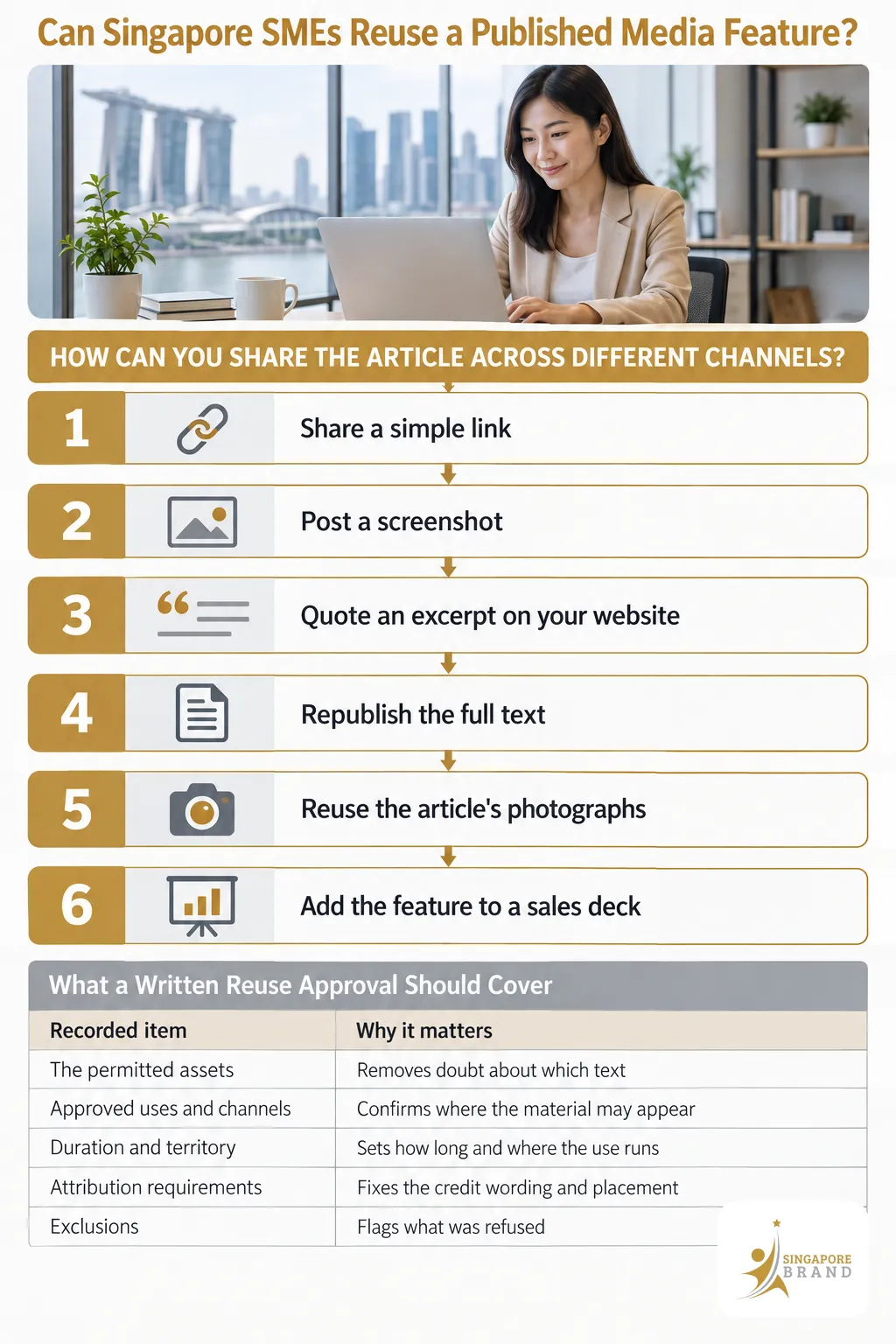
1. Share a simple link
Linking is the proposed starting point. An ordinary hyperlink to the publicly accessible article, using its title and your own introductory words, is low-risk and keeps readers on the original page. Treat it as a sensible default rather than a blanket guarantee, and check your applicable terms first.
2. Post a screenshot
A screenshot can reproduce page text, layout and separately licensed photographs. We suggest checking those rights and asking where permission is needed. Identify the channels you intend to post on, and check the page text, design and any images before uploading. Existing rights or applicable copyright exceptions may already permit the use, so asking is a safety step rather than a universal legal requirement.
3. Quote an excerpt on your website
A short, approved excerpt with a visible source credit and a link to the original is the workable middle ground. Check whether existing rights or exceptions already cover your intended use. Where they do not, request approval for the exact wording, the credit and the link.
4. Republish the full text
Full-text republication calls for a check of the rights involved. Check first whether you already own or are licensed to reuse the text — clause 3.4 of Singapore Brand's terms may apply if the feature was fully paid. Otherwise, seek written permission or use a short teaser that links to the original article.
5. Reuse the article's photographs
Check photograph rights separately, even when the images appeared inside your feature. Existing rights or an applicable exception may already permit the intended use. The photographer or another rights holder may control the licence. As a purely hypothetical illustration, imagine a chef portrait cleared for use in an article but not in a paid social advertisement. The publication's permission alone would not cover the advertisement, and that reuse would wait on the photographer.
6. Add the feature to a sales deck
In a sales deck, distinguish a link from inserted text, screenshots and photographs. A link is the lightest touch. If you want visuals in the slides, specify whether the deck will circulate externally and whether it will be downloadable as a PDF, because those details shape the scope of any approval.
How Should a Permission Request Be Framed?
To request permission to use an article screenshot, identify the article, intended channels and other assets. Our team suggests the checklist below as a way to explain the proposed use. It is not a set of fields any publisher currently requires.
1. Details a good request includes
A well-framed request covers the whole intended use in one email:
- The article URL and title
- The exact assets you want to use, with a mock-up if possible
- The channels, audience and territory of use
- How long you want to use the material
- Whether the use is organic or paid
- Proposed edits, crops or translations
- Your company and contact details
These details can help a reviewer understand the request, though they do not guarantee approval.
2. What a written approval should record
A written approval is worth keeping. It should identify the recipient, the permitted assets, the approved uses, the duration, the territory, the attribution, any exclusions, and whether an agency may act on your behalf or sub-licensing is allowed. This is a proposed record of scope, not any publisher's confirmed template, but it protects both sides if questions arise months later.
3. A hypothetical illustration
Consider a hypothetical local interiors company seeking to share its feature on LinkedIn, its website and a customer-facing PDF deck. It wants a screenshot, a short extract, a cropped portrait, a logo overlay and a Mandarin translation.
Even in this invented example, each element — the screenshot's images, the portrait's licence, the logo overlay, the translated wording — needs its own scope decision. That asset-by-asset review is exactly how an experienced practitioner would work through such a request.
Channel-by-Channel Guide to Sharing Your Feature
| How you want to use it | Proposed starting point | What to check first |
|---|---|---|
| Link to the article | Share the URL with its title and your own words | Your applicable order terms |
| Screenshot | Ask the publisher before uploading | Page text, layout, embedded photos, target channels |
| Short excerpt | Approved wording with a credit and a link | Existing rights or exceptions; the exact wording |
| Full text | Written permission, or a teaser plus link | Ownership under your agreement; third-party rights |
| Photographs | Clear separately, every time | The photographer's licence or other rights holder |
| Sales deck | A link on the slide | External circulation, downloadable PDF, inserted assets |
When Does the Answer Change for Press Releases, Editorial and Listings?
The rights and the representation both matter. Our team's suggested approach is to assess both, rather than relying on whether a placement was paid. The same principle applies to a listing of network security companies in Singapore.
For permissions and editorial enquiries, Singapore Brand publishes the contact info@singaporebrand.com.sg, and you can also reach the team through the Singapore Brand contact page. Confirm the routing before treating any inbox as a permissions contact.
1. A customer-supplied press release
With a press release your business supplied, you may already own the submitted text and have rights to reuse it. The publisher's headline, editing, page design and separately sourced images remain distinct questions. Paying for distribution does not automatically buy the publication layout or an endorsement.
2. An editorial feature
Rights in an original interview or editorial feature depend on its creators, the applicable agreements and any assignments. We would protect the distinction between reporting and a testimonial. An article that describes your company is different from an advertisement you can edit at will.
3. A Best in Singapore listing
For a curated listing — say, a company named among the top 10 best network security companies in Singapore — the business should keep the category, publication date and any qualification visible and accurate. Singapore Brand's Best in Singapore pages describe an endorsement seal, so whether a listing functions as an endorsement depends on the specific page and terms, not a blanket rule.
What a Written Reuse Approval Should Cover
| Recorded item | Why it matters |
|---|---|
| The permitted assets | Removes doubt about which text, images or screenshots are covered |
| Approved uses and channels | Confirms where the material may appear |
| Duration and territory | Sets how long and where the use runs |
| Attribution requirements | Fixes the credit wording and placement |
| Exclusions | Flags what was refused, such as edits or paid ads |
| Agency and sub-licensing rights | Clarifies whether partners may act on your behalf |
Does Giving Credit Replace Getting Permission?
No — a credit line is courtesy, not a licence. Naming the publisher and linking to the original is good practice and worth settling in any permission request, but attribution on its own does not authorise reuse.
According to the Intellectual Property Office of Singapore, copyright exceptions can permit some uses without permission. Fair-use factors include the purpose, amount taken and effect on the potential market. The Copyright Act 2021 took effect on 21 November 2021. IPOS also explains that public use of certain works can trigger creator identification, subject to conditions and exceptions. A publisher credit alone should not be assumed to satisfy that obligation or to grant permission.
Where credit is given, confirm its form for the intended format. Options to discuss include:
- A line below a website excerpt
- A visible source on an approved screenshot
- A named mention in a social caption
- A readable source on each sales-deck slide No one can promise that a particular commercial excerpt or screenshot qualifies as fair use without reviewing the intended use, so seek specialist review where it matters.
Conclusion
A published feature is made of many parts, and the rights to those parts can differ. Check your order and agreement first. For screenshots, full text, photographs or alterations, check existing rights and ask where permission is needed.
Our team helps Singapore SMEs seek coverage through editorial features, executive interviews and curated Best in Singapore guides. We also offer press releases and a business directory. For reuse questions, we suggest checking each asset's rights and seeking confirmation where needed.
For editorial and listing enquiries, email info@singaporebrand.com.sg. Confirm the routing before treating it as a permissions contact.
Put Your Coverage to Confident Use
Whether you need guidance on reusing a feature responsibly or want your brand featured in our next story, our editorial team is ready to help.
Frequently Asked Questions
Sharing an ordinary link to the article, with its title and your own introduction, is a low-risk starting point. For a screenshot or substantial text, check the terms of the feature or ask the publisher first.
Photographs can carry their own rights, often held by the photographer or another rights holder. Check the requested reuse separately, including existing rights and applicable exceptions, before using an image in advertising or a sales deck.
A link to the article on a slide is usually the lightest option. Inserting text, screenshots or photographs needs a rights check, and you should confirm whether the deck will circulate externally or be downloadable as a PDF.
No. Copyright generally depends on the creator, the commissioning circumstances and the agreement. Singapore Brand's published terms assign rights in the final version of fully paid Products to the customer, but which assets that covers requires review of the order.
Credit is good practice, not permission. Copyright exceptions and fair-use factors may cover some uses, but a commercial excerpt or screenshot should be reviewed — and where needed, approved — before you rely on it.

Singapore Brand
Author
We are dedicated to promoting and celebrating business brands in Singapore. We share the inspiring success stories of homegrown brands, highlighting their achievements and growth.