

A Singapore business details update can unravel when a legal rename reaches public listings at different times. A company can legally adopt a new name on Monday. By Friday, it may still appear under the old name in Google Maps, a directory listing and an old media feature. Each of those records was touched by a different hand — or never updated at all.
For Singapore small and medium enterprises (SMEs), business details now live in many places at once. The official record is held by the Accounting and Corporate Regulatory Authority (ACRA). Other records sit on your own website, Google Business Profile and industry directories. They also appear on social pages and editorial features written about you over the years. After a rename, a move, a new phone line or a changed service list, these records can drift apart quickly.
The consequences are practical, not cosmetic. Customers may call a number nobody answers or turn up at a former unit. They may also trust a listing that no longer reflects what you do. Search engines, for their part, read consistency across records as a quiet signal of an active, well-run business.
In this blog, we explain what to update first and in what order. It covers Bizfile deadlines and special resolutions, Google Business Profile edits, duplicate-listing merges and recommended correction-request fields.
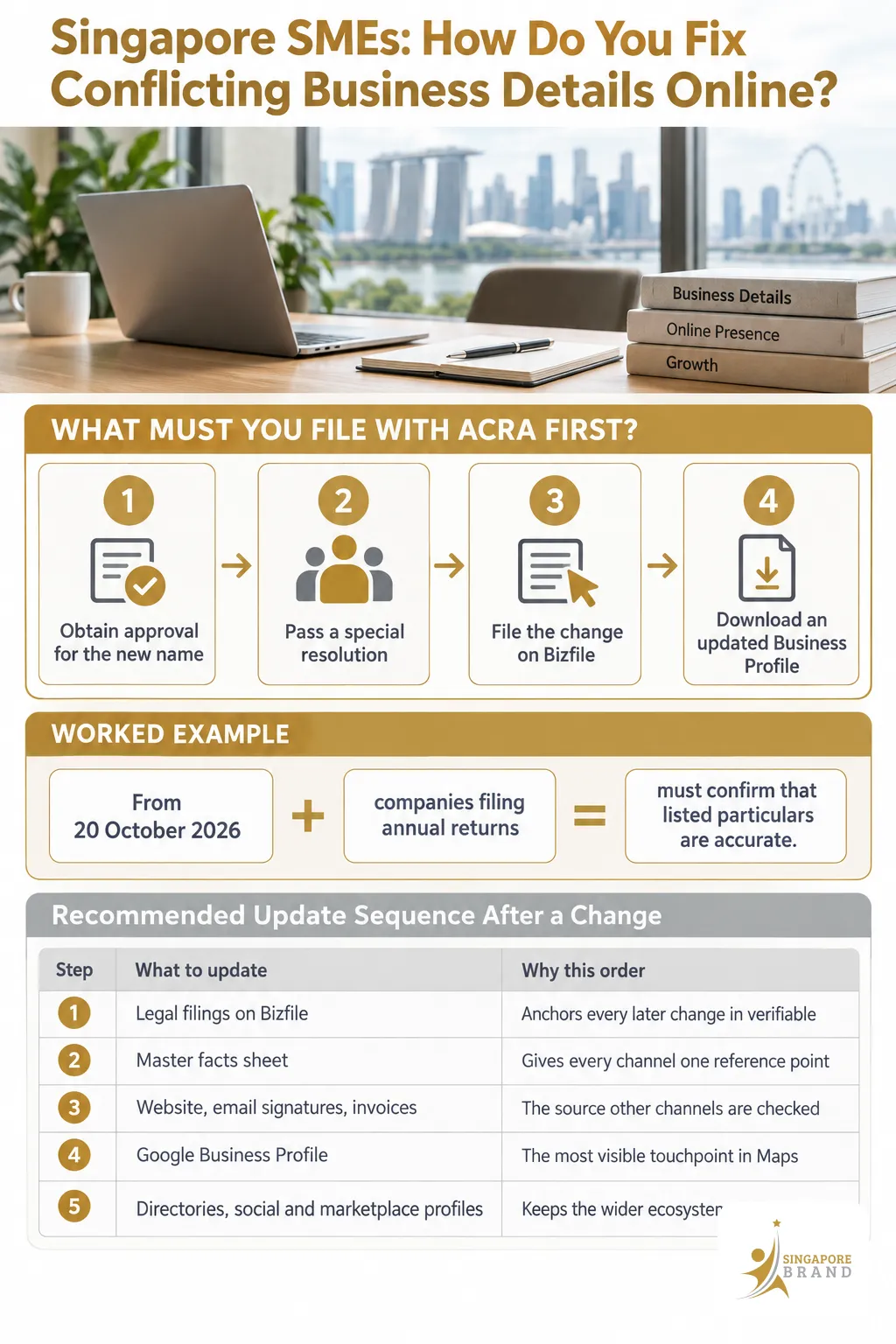
What Must You File with ACRA First?
The first task is to update ACRA business information through Bizfile, the national business registry portal. ACRA's current guidance requires registered entities to update core details — the entity name (once approved), business activities and registered-office address — generally within 14 days of the change. Foreign companies registered in Singapore generally have 30 days.
Scope matters here. These deadlines cover only the fields ACRA records. They say nothing about your customer-facing phone number, website, opening hours or directory entries, which follow their own timelines.
A Singapore company name change follows a defined sequence, and skipping a step is what usually creates conflicts later:
1. Obtain approval for the new name
ACRA must approve the new entity name before you file the change. A rebrand, a new trading name or a refreshed logo does not by itself change your legal entity name.
2. Pass a special resolution
For a local company, a special resolution authorising the name change must be passed and uploaded in PDF when the entity information is updated. Your company secretary typically drafts and files it.
3. File the change on Bizfile
Submit the update within the filing window. Many SMEs delegate this paperwork to providers of company secretarial services in Singapore to avoid missed deadlines and rejection notices.
4. Download an updated Business Profile
ACRA's Business Profile sets out basic entity information, including the Unique Entity Number (UEN) and the entity name. Keep a copy — it is the evidence most publishers will ask for later.
Which Source Is Authoritative for Which Business Detail?
The answer depends on which kind of detail is in dispute. A practical framework we recommend keeps three tiers in separate sections of one worksheet — this is a record-keeping habit, not an official standard.
Tier one is legal information: the exact registered name, UEN, entity status and registered-office address. ACRA is authoritative for these, so preserve punctuation and legal suffixes rather than copying a shortened website version.
Tier two is public trading information: the brand or trading name, customer-facing address, phone, email, website and opening hours. Your own controlled website and an authorised company-domain confirmation are primary here, with your Google Business Profile and current storefront evidence as checks.
Tier three is marketing: tagline, categories, service descriptions and claims. These come from the business, but remain subject to each publisher's editorial standards.
Flattening the three tiers into one blob is what usually goes wrong. Businesses swap the legal name for a brand name, treat the registered office as a shop customers can visit, or push an outdated category into every directory. If sources disagree, do not pick one universal winner — decide which source governs that specific field.
One distinction deserves care: a registered office is a legal address for official notices, while an operating address is where customers actually go. The two can legitimately differ. This is an operational distinction rather than legal advice, so confirm your own filing obligations for your circumstances.
Authoritative Sources for Each Business Detail
| Detail | Tier | Authoritative source | Where to update it |
|---|---|---|---|
| Registered name, UEN, entity status | Legal | ACRA record | Bizfile |
| Registered-office address | Legal | ACRA record | Bizfile |
| Trading name, operating address, phone, hours | Public trading | Your website and an authorised company-domain confirmation | Website, Google Business Profile, directories |
| Tagline, categories, service claims | Marketing | The business, subject to each publisher's standards | Directories and media profiles |
In What Order Should You Update Google, Directories and Media Profiles?
Complete relevant legal filings first. Then move outward from the channels you control to those you do not. The five actions below begin after those filings. We offer this as a recommended order, not a tested formula or mandatory rule.
The sequence gives each later action something verifiable to point at.
1. Build one master facts sheet
After completing legal filings on Bizfile, list every current value — legal, trading and marketing — with its source and effective date. Every later update refers back to this sheet.
2. Update your controlled channels first
Refresh your website, email signatures and invoices on the effective date. These are the references other channels get checked against. If the transition also involves your mail setup, our roundup of business email providers in Singapore can help you keep the domain consistent.
3. Refresh your Google Business Profile
Update the profile immediately after your own site. It is usually the most visible touchpoint, because a wrong address or phone appears directly in Maps and search results.
4. Work through directories, social profiles and marketplaces
Update them in order of customer traffic. Where a move does not change the registered office, you can update customer-facing location details using the confirmed move date, without waiting for an ACRA filing — again, confirm your own obligations first.
5. Audit search results and old pages
Search your old and new names, former domain and distinctive phone digits. Note every page that needs a correction request, and log it for follow-up.
Recommended Update Sequence After a Change
| Step | What to update | Why this order |
|---|---|---|
| 1 | Legal filings on Bizfile | Anchors every later change in verifiable evidence |
| 2 | Master facts sheet | Gives every channel one reference point |
| 3 | Website, email signatures, invoices | The source other channels are checked against |
| 4 | Google Business Profile | The most visible touchpoint in Maps and search |
| 5 | Directories, social and marketplace profiles | Keeps the wider ecosystem consistent |
| 6 | Search-result audit | Catches old pages and duplicate listings |
How Do You Fix Duplicate Business Listings in Singapore?
Search under both names and compare stable identifiers rather than branding. A matching name alone proves little, because related companies, branches and franchisees often share branding and contact details.
A stale phone number or address can cause particular customer harm. The risk rises when it appears on a high-ranking page and in Google results. Check that pairing first.
1. Search under both names
Look through Google, listed directories and every platform where your business appears. Include pages written about you. Search the old and new names, former domain and recognisable phone digits.
2. Compare identifiers, not branding
The UEN is the strongest continuity signal where it is shown. The root domain, phone number and address are useful supporting clues. Do not treat any single shared field as proof of the same entity.
3. Choose one master record
Once continuity is confirmed, treat one current profile as the master, move useful non-conflicting information into it, and ask each directory to merge or remove the duplicate. Do not merge separate legal entities or genuine branches simply because their branding looks alike.
Duplicate-Listing Clues and What They Confirm
| Clue | What it suggests | Caution |
|---|---|---|
| Matching UEN | Strong continuity signal | Definitive where it is shown |
| Same root domain | Strong supporting clue | Related entities can share a domain |
| Same phone or address | Useful supporting clue | Branches and franchisees may share these |
| Name similarity alone | Weak evidence | Shared branding is common among related companies |
What Belongs in a Correction Request to a Publisher?
A clear request identifies the exact page, the exact change and your authority to make it. The recommended checklist below gives a publisher the information needed to assess it.
Treat the checklist in the table below as a suggested submission format rather than any single publisher's formal policy:
The most common gap is not evidence but scope. State which old detail you are replacing, and whether an address is a registered office, headquarters, showroom or branch. If you are unsure where to start with us, reach out through our contact page.
1. Evidence for legal fields
For a registered name, UEN or registered-office change, expect a publisher to ask for a current ACRA record or Business Profile. It is the cleanest proof that a legal detail has changed.
2. Evidence for operating details
For a phone, email, website, operating address or category change, we recommend an email from the company's own domain alongside the updated official website. Letterhead, lease extracts and press releases are corroboration rather than automatic proof.
3. Handling old editorial features
Distinguish between correcting a hazardous current contact detail and rewriting the substance of an old article. A dated note linking to your current profile is one editorial option; preserving the original piece as history is another. Publishers decide these case by case.
Correction Request Fields and Priorities
| Field | Priority | Why it matters |
|---|---|---|
| Exact page URL | Load-bearing | Without it the request stalls |
| Old value and new value | Load-bearing | Shows precisely what is being replaced |
| Registered name and UEN | Load-bearing | Ties the request to the right entity |
| Effective date | Load-bearing | Tells the publisher when to apply the change |
| Requester name, role, company-domain email | Load-bearing | Establishes authority to request the change |
| Field-appropriate evidence | Load-bearing | An ACRA record for legal fields; website confirmation for contact details |
| Reason for the change | Nice-to-have | Useful context for the editor |
| Replacement logo or revised description | Nice-to-have | Speeds up the refresh |
How Do You Keep Your Details Accurate Going Forward?
Treat your business details as a managed record with owners and review dates, not a one-off cleanup. Details drift again the moment your next change happens, so build the habit before you need it.
1. Keep a tracking sheet
A suggested tracking-sheet template can include:
- current and former names, plus the UEN
- affected URLs and old and new values
- evidence relied on and the effective date
- an action owner, completion status and next review date
It is a working aid, not a compliance record.
2. Confirm your particulars in your annual return
From 20 October 2026, companies filing annual returns must confirm that listed particulars are accurate. This includes directors, officers and the registered office. Review your Bizfile record before filing. A corporate service provider in Singapore can prepare the return for you.
3. Schedule a periodic review
Re-verify each tier of your worksheet after every major change, and at least once a year. Check the website against the ACRA record, and the directories against the website.
Conclusion
Conflicting details online can stem from update sequence rather than intent. A Singapore company name change and a business address change need the same discipline. Update your ACRA business information first. Keep legal, trading and marketing details in separate tiers. Then bring your website, Google profile and directories into step. Finish with a duplicate check and a well-scoped correction request for any page you do not control.
For an SME, a checklist and tracking sheet can make a transition easier to manage. Keep both, and review them at least once a year.
At Singapore Brand, we help local companies present accurate, consistent details across our directory and editorial features. We also publish Best in Singapore guides. If a listing or feature about your business needs updating, send a clear, well-evidenced request. Our team can then help put it right.
Get Your Business Details Working as One
Whether you have just renamed, relocated or refreshed your services, we can help you present one accurate, consistent story across our directory and editorial pages.
Frequently Asked Questions
ACRA's guidance gives most local entities 14 days from the change to update the entity name, business activities or registered-office address via Bizfile. Foreign companies generally have 30 days. These deadlines cover ACRA-record fields only.
No. The registered office is the legal address for official notices, while the operating address is where customers find you. The two can differ, but label each clearly so directories and publishers update the right field.
Obtain approval for the new name, prepare a special resolution for a local company, file the change on Bizfile within the deadline, then download the updated Business Profile as evidence for later corrections.
Search both names plus the former domain and distinctive phone digits, compare the UEN, root domain and contact details to confirm continuity, then choose one profile as the master and ask each directory to merge or remove the duplicate.
For legal fields, a current ACRA Business Profile. For operating details, an email from your company domain that matches the updated website. Always state the page URL, the old value, the new value and your role.

Singapore Brand
Author
We are dedicated to promoting and celebrating business brands in Singapore. We share the inspiring success stories of homegrown brands, highlighting their achievements and growth.