

HDB states that contractors must be listed in its Directory of Renovation Contractors before carrying out renovation work in HDB flats. It also states that listing does not endorse or guarantee the quality of a contractor’s work. Checked on 1 October 2026.
That distinction matters whenever a Singapore SME describes itself online. A website, directory listing or media profile may contain genuine records but still overstate what those records establish.
A licence is not automatically an endorsement. A badge is not necessarily an award record. A founder’s earlier experience is not the same fact as an entity’s registration date.
This guide sets out the Singapore Brand team’s professional editorial judgement on how SMEs can write supportable profiles without overstating their evidence. It is recommended practice rather than legal advice, and it does not describe a confirmed Singapore Brand policy. It explains how to identify the operating entity. Then it covers checking regulated credentials against the right official record. It also covers narrowing claims about awards, clients, dates and results to the evidence.
What Goes Into a Verifiable Singapore SME Business Profile?
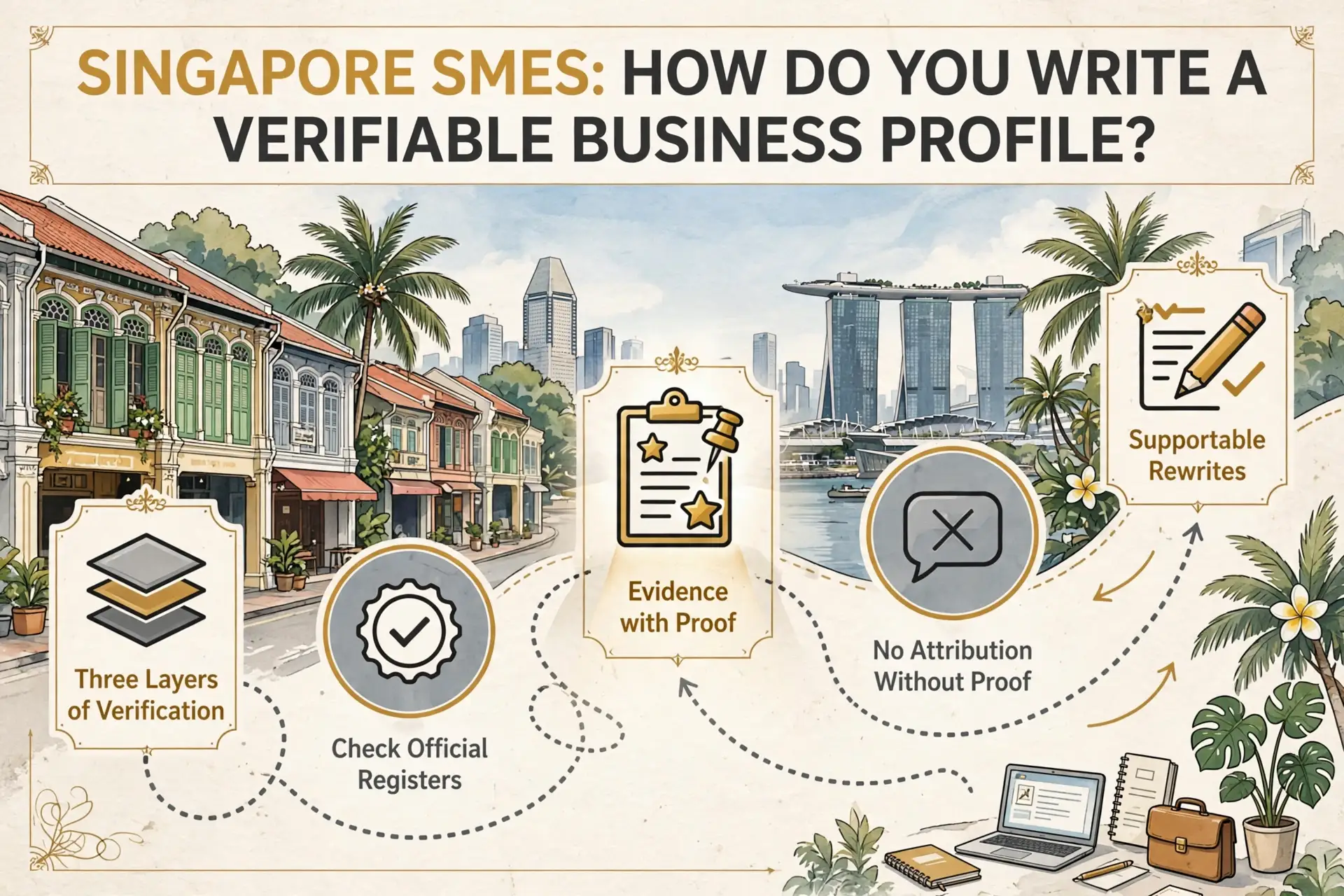
A verifiable Singapore SME business profile rests on three layers. First, use a top 10 best company secretary service in Singapore to identify the legal entity clearly. Second, match every material claim to a named source. Third, use wording that goes no further than that source allows.
The Singapore Brand team’s professional editorial judgement is that a profile should separate the public-facing brand, the registered entity and the people behind it. This is recommended editorial practice, not a confirmed Singapore Brand procedure.
1. Separate the brand, the entity and the people
Checked on 1 October 2026, ACRA’s Bizfile guidance states that an entity can be searched by name or Unique Entity Number (UEN). ACRA guidance also explains that a Business Profile can be used to check registered information, including the entity name, UEN, live status and registered address. The record confirms registered information, not service quality, expertise, business scale or current delivery capability.
2. Explain a trading name that differs
Where the brand differs from the registered entity, state the relationship plainly. One sentence, such as noting that the brand is operated by the registered company and citing its UEN, removes the guesswork. Confirm the exact brand-to-entity relationship before publication. This is a clarity recommendation, not a rule.
3. Label what a 'since' date represents
A registration date, a brand-launch date, a predecessor-business date and a founder's earlier experience are different facts. Publish only the date you can document, and label what it represents. Otherwise a 'since' claim quietly stretches your history beyond what the records support.
Which Official Registers Back Up Regulated Claims?
For a regulated activity, check the exact claim against the current record maintained by the responsible authority on the publication date. The official pages checked on 1 October 2026 are:
- ACRA Bizfile
- HDB’s Directory of Renovation Contractors
- MAS’s Financial Institutions Directory
- MOH’s HCSA pages
- MOM’s employment agency directory
- SkillsFuture Singapore’s private-education records
A licence, register entry, MAS Financial Institutions Directory listing or support-scheme participation is not automatic government certification or endorsement. Check the entity, activity, status and any relevant individual role. State only what the record establishes.
1. Financial services: MAS directories
Checked on 1 October 2026, MAS directs users to its Financial Institutions Directory to view financial institutions and their licence types or activities. MAS also provides the Financial Institution Representatives Register for individuals appointed to conduct regulated activities or provide financial advisory services. Check the exact entity, regulated activity, licence status and individual role on the publication date. Directory inclusion is not a general endorsement by MAS.
2. Healthcare: HCSA licences and professional boards
Checked on 1 October 2026, MOH states that healthcare providers offering regulated healthcare services need the relevant HCSA licences before offering those services. MOH also states that the professional boards maintain registers of healthcare professionals. Verify the particular service, provider entity and practitioner. One practitioner’s registration does not mean the company is licensed for every service it mentions.
3. Employment agencies: the MOM directory
Checked on 1 October 2026, MOM states that an employment agency needs a licence to operate. MOM’s Employment Agencies and Personnel Search lets the public search licensed agencies and personnel. Confirm the licence holder, licence type and current status. Not every staffing or HR business performs regulated placement activity, so assess the activity before applying that label.
4. Renovation and private education: listings, not endorsements
HDB’s Directory of Renovation Contractors requires listing before renovation work in HDB flats. Listing does not endorse or guarantee work quality. Both points were checked on 1 October 2026. SkillsFuture Singapore materials distinguish school registration from EduTrust certification. For either type of claim, verify the institution’s current status through the applicable official record. Avoid implying government endorsement unless the authority expressly uses that wording.
Registers to Check for Regulated Claims
| Sector | Where to check | It confirms | It does not confirm |
|---|---|---|---|
| Entity basics | ACRA Bizfile entity search and Business Profile | Registered name, UEN, live status, registered address | Service quality, expertise, scale |
| Financial services | MAS Financial Institutions Directory and representatives register | Licence, regulated activity, representative status | General endorsement by MAS |
| Healthcare | MOH HCSA licence records and professional boards | Licence for a regulated service, practitioner registration | Company-wide competence for every service |
| Employment agencies | MOM Employment Agencies and Personnel Search | Licence holder, licence type, current status | That every staffing firm is a licensed agency |
| Renovation in HDB flats | HDB Directory of Renovation Contractors | Listing requirement is met | Endorsement or guarantee of work quality |
| Private education | SkillsFuture Singapore records | PEI registration, EduTrust certification status | Government endorsement |
How Do You Evidence Awards, Client Names and Results?
Each of these claims can be published if pinned to evidence that matches exactly what is claimed. Permission is also needed wherever a third party is involved.
1. Name every element of an award claim
An award claim should identify the recipient, the organiser, the year, the category and the result. Best of all, link to the organiser's original announcement page. A certificate or badge alone is weaker evidence than the organiser's own record. Treat this as an editorial evidence standard, not a legal rule.
2. Get written permission for named clients
Named client logos, testimonials and case-study facts should be published only with written permission covering the specific use. That permission should cover the client name, logo, any quotation, the case-study facts and the publication itself. A contactable reference helps verification but does not replace publication permission. This is a prudent editorial standard, not a complete statement of Singapore privacy, contract or intellectual-property law.
3. Define the numbers behind an outcome claim
A quantified outcome should define the metric, the baseline, the time period, the comparison and the business's own contribution. If the client will not go on record and will not permit private verification, remove the number. Do not replace it with a vague claim of significant savings. A vague outcome claim is still an unverified outcome claim.
Why Is Attribution Not a Fix for an Unsupported Claim?
Attributing an objectively checkable claim to a company does not substantiate it. It repeats the claim with a source label attached.
For example, saying that a company describes itself as one of the best security companies in Singapore still communicates a market-ranking claim. Attribution can help with genuine opinion, intention and founder narrative. It does not validate rankings, customer totals, credentials or performance claims.
The Singapore Brand team’s professional editorial judgement is to remove or replace unsupported superlatives. That includes “leading”, “best”, “number one”, “first” and “only”. Use a narrower factual statement instead. Keep them only where the business can show a defined market, a comparison method and credible evidence. This is recommended editorial practice.
Common Claims and the Evidence They Need
| Claim type | What usually goes wrong | Evidence that keeps it |
|---|---|---|
| 'Leading' or 'best in Singapore' | No defined market or comparison method | Remove, or state a narrow documented fact |
| 'Award-winning' | Year, organiser, category or result missing | Organiser's original announcement, all elements named |
| 'Trusted by thousands' | No counting method, date range or records | Dated summary with method explained, or removal |
| 'Established since 19XX' | Date conflated with predecessor or founder start | The documented date, labelled as to what it is |
| 'Government-certified' | Listing or licence mistaken for endorsement | Exact register, status and date checked |
What Can a Young SME Publish Without Awards or Reviews?
A young SME can build a credible profile from specific, supportable facts that need no awards or reviews. The Singapore Brand team’s professional editorial judgement is that clear, documented facts give readers more to act on than broad promotional language.
Each fact still needs its own evidence, or clear founder attribution where it is a statement of intention or personal experience. Once these elements are in place, our step-by-step guide on how to build a brand in Singapore can help turn documented facts into a story readers remember.
Safer facts a young SME can publish include:
- Legal identity: the registered entity, UEN and live status, as shown in the official record.
- Service area: the markets, neighbourhoods or industries you actually serve.
- Defined services: what you deliver, in plain terms, matched to your own documentation.
- Qualifications: relevant credentials of the founder or team, each traceable to its register.
- Process: how an engagement runs, from first enquiry to delivery.
- Specifications and pricing basis: product details and how your pricing is structured.
Hypothetical Before-and-After Rewrites
| As submitted | Supportable version | Why it works |
|---|---|---|
| 'Singapore's leading one-stop provider, trusted by thousands' | Registered entity plus named services, no ranking | Removes ranking, total and scope implication |
| 'Award-winning team serving customers for decades' | Award, year and category, per the organiser's results | Every element checkable at its source |
| 'We dramatically cut a major client's costs' | Metric, period, baseline and written client approval | Claim limited to what the records support |
What Do Supportable Rewrites Look Like?
A good rewrite keeps the promotional energy but swaps each unverifiable element for a documented, narrowly stated fact.
The pairs below are hypothetical illustrations, not real submissions or client cases. The bracketed details are placeholders. Substitute your own documented facts, and keep the wording no broader than what those facts support.
1. Drop the unproven ranking
Before: 'We are Singapore's leading one-stop provider, trusted by thousands.' After: State the documented services the company provides to SMEs. The rewrite removes an undefined ranking, an uncounted customer total and the one-stop implication.
2. Name the award precisely
Before: a profile that claims an unverified award history with no award name, year or organiser. After: identify the award name, year and category, then refer readers to the organiser's published results. Every element can now be checked at its source.
3. Scope the outcome claim
Before: a vague claim that a major client's costs were cut dramatically. After: a statement that gives the pilot length, the metric, the amount of change, the prior period baseline and written client permission. The claim now names its metric, period, comparison and permission.
Conclusion
A Singapore SME profile can overstate its evidence even when the underlying record is genuine. The Singapore Brand team’s professional editorial view is that the safest approach is to identify the legal entity through ACRA. It also means matching regulated claims to the current record of the responsible authority. It means naming awards precisely, securing client permission and defining every numerical outcome.
When unsupported superlatives are removed, the remaining profile is often clearer. The profile becomes a defined entity, specific services and facts readers can check.
Use this approach when preparing a profile for publication or a directory listing. If you want editorial support to shape your documented business story, contact us.
Get Your Business Profile Publication-Ready
Send us your draft profile for editorial support in matching claims to available evidence before publication.
Frequently Asked Questions
No. An ACRA record confirms registered facts such as the entity name, UEN, live status and registered address. It does not prove service quality, expertise or scale.
Not automatically. A licence, register entry, directory listing or scheme participation does not by itself mean government endorsement. State the exact register, current status and date checked instead.
Remove it or narrow it. As a recommended editorial standard, an award claim should identify the recipient, organiser, year, category and result, ideally with the organiser’s original announcement.
No. Attribution does not substantiate an objectively checkable claim. It can suit opinion and founder narrative, but not unsupported rankings, customer totals, credentials or performance claims.
Yes. Publish specific, documented facts: legal identity, service area, defined services, qualifications, process, specifications and pricing basis. Each still needs its own evidence.

Singapore Brand
Author
We are dedicated to promoting and celebrating business brands in Singapore. We share the inspiring success stories of homegrown brands, highlighting their achievements and growth.